The Bridgwater Mayor's Chain of Office and Robes


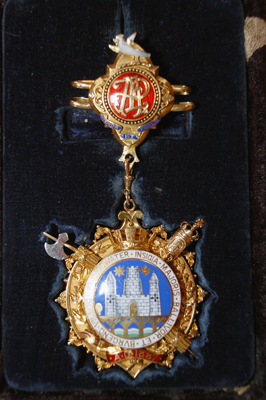
The Mayor’s chain was given to the corporation by E.J Stanley Esq., M.P to commemorate the Golden Jubilee of Queen Victoria in 1887.

At the monthly meeting of the Bridgwater Town Council on September 15 1887 it states.

The Mayor (Alderman Peace. J.P ) brought under the notice of the Council the fact of having in conjunction with E. J Stanley, Esq. M.P for the Bridgwater Division and the following subscribers, purchased a Gold chain, consisting of one centre and eighteen ordinary links with pendant or badge for the use of the Borough forever and now formally presented the same to the council.

That the best of thanks of the council be offered to his worship the mayor and other subscribers to fund in question and that chain and badge be accepted with very best thanks, and a copy of this resolution be sent to each subscriber.


Ald G. B.SULLY
Cllr J. H. WADDON
Mr PAUL O. H. REED
Ald W. T. HOLLAND
Mr A. G. BARHAM
Mr F. J. C. PARSONS
Ald C. SYMONS
Mr E. LILLY
Mr A. G. BARHAM
Ald F. J. THOMPSON
Mr W. BRICE
Mrs ELSE
Cllr W. J. R. POOLE
Mr JAS. COOK JUNR
Rev N.H.C RUDDOCK
 

The Mayoral Insignia is like a uniform and is worn as the outward and visible sign of the position rather than the person.

So while the Mayor is a different person each year, the uniform never changes.

On special occasions the Mayor wears a large red cloak with fur around the edge and a black hat with a heavy gold chain for example at Council meetings and Civic Ceremonies.

On formal occasions the Chain of Office is worn with shield shaped badge attached.

There have been five Mayoral robes; the first purchased in 1877 with others being purchased over the years by various mayor’s.

These two have sable fur. One robe was even purchased from a second hand shop in town and all have artificial fur.


The Bridgwater Maces


It is very probable that these maces were borne when Monmouth was proclaimed King in 1685 and also when James ll visited the town in the following year
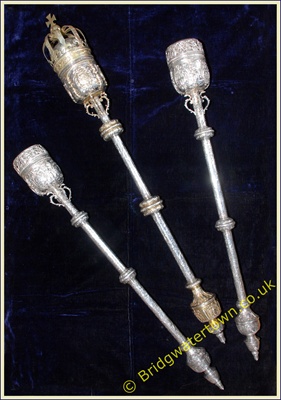
All three are of the Restoration Period and the largest the Warwick Mace, dates from the first year of Charles the Second's reign.

This is a beautiful piece of craftsmanship in silver, and measures 3ft 2in from the acorn at the smaller end to the cross surmounting an orb - badly restored in brass - at the larger end. The Royal Arms are contained in a circular plaque beneath the arcading of the crown, below the base of which, in relief, is the inscription "Charles II, King of England, Scotland, Ireland and France, 1660."

The head is divided into four panels, each separated by a grotesque caryatid figure, and enclosing within scroll-work and escutcheon, one of which contains the Bridgwater town arms - a castellated bridge - and the others a cotises cross on a gold ground."

"The whole is richly ornamented with the Stuart symbols of acorns and oak leaves, worked in repousse and chased, and supported by four cast scroll-brackets."


"The shaft is divided into three unequal parts below the head by two gadrooned knops, the oak leaf and acorn motive being engraved throughout its entire length. The foot also contains repoussé ornament, and together with the knops, brackets, head and crown is of silver gilt."

"There is no doubt that this mace was carried when the ill-fated Duke of Monmouth was proclaimed King in Bridgwater Market Place in July 1685, and in all probability it preceded James II on the occasion of his visit to the town in 1686."

"The two smaller maces - each measuring 2ft 7in long - are similar in most respects to the largest except that they are not surmounted by crowns, having a cresting of entwined oak leaf ornament with escutcheons instead. In two of the panels a crown above a sprigged rose takes the place of the cotises cross."